Demagnetizing - Polishing

Dealing with Low Levels of Magnetism in the Steel
(note - the new Moe-Joe cells are totally NON-Magnetic - this is if you have the former version which had some magnetism around the steel)
With the new design, one of the hemispheres has a lip rolled in. This does induce a little magnetism in the steel, because the stainless steel is being cold worked. I personally do not feel it affects the performance of the cell very much. 95% of the surface area of the hemispheres are almost completely non-magnetic. And, if you will watch the videos of the newest improved design, you will see arriving at stage 3 is not a problem. However, if you adamantly want completely non-magnetic steel, then here are a couple of things you can do:
Heat Treating
From Alex Schiffer's Experimenter's Guide to the Joe Cell
"Regarding heat treating, as the Curie point of most stainless steel is 800F and higher, our heat treatment must exceed this temperature. Two methods that work are:
Local advice from a Melbourne heat treatment operator: he suggests to place the material in a vacuum oven at 1050 C for 30 mins. It is then quenched in Nitrogen gas to cool back to atmospheric temperature over a relatively short time. The final finish is almost like chrome.
0 2 ‑ TM Technology, suggest 80OF to 120OF for V2 to 2 hours
http://www.tinmantech/html/faq‑stainless‑working‑joe‑c.html"
Moshe: I was told that the temperature for heat treating should be between 700 - 800 o Celsius - and to bring the metal up to that temperature slowly - over 1 hour, and then bring down very slowly for 8-12 hours. IMPORTANT - this must be done in a special Vacuum kiln and NOT in a regular oven. Vacuum is important.
AC Demagnetizing
At many "Tool and Die shops" you can ask for an AC Demagnetizing unit and have them zap your hemispheres with the unit. Here is an URL with an example of such a device -
http://www.gaussbusters.com/adgSpec.html
Have any other techniques for demagnetizing that you know work? Please share them with us
To Polish or Not to Polish?
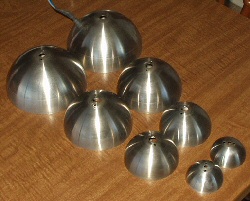
Click here to see more really nice polishing jobs from the Global Moe-Joe Cell Community
Truth is, polishing looks nicer. But does it help the cells perform any better? Answer - Most likely. Orgone reflects off shiney surfaces better than rough or unpolished surfaces and since the Moe-Joe cell is NOT a hydrogen producer, then polishing does increase the overall good feel and orgone production of the cell. The polishing makes the cells less responsive to the current - the cells respond slower to the build-up of current. Perhaps it is because we see less surface area to react with the water. The polishing of the spheres will also improve the cell's function for using high voltage with little no current and a high frequency. The polished surfaces will respond better to the High Voltage and frequency. The surfaces that are best to polish are the inside of the outer sphere, the outside of the inner sphere, and both sides of the neutral(s). If all the surfaces of the cells are polished, that is okay too. It's just polishing is quite labour intensive, and sometimes expensive, so to save time and money, one can just polish those surfaces and not the rest. Although, to a see a nice shiney Moe-Joe cell is very nice indeed!
|